[July 16, 2026] Standard Energy Marks Completion of Vanadium-Ion Battery Energy Storage System in Kyoto, Japan
본문
□ First overseas installation of a vanadium-ion battery energy storage system
□ VIB ESS expected to support Japan’s expanding EV charging infrastructure
□ Technology aims to address emerging power challenges driven by electrification
First Overseas Installation of a Vanadium-Ion Battery ESS
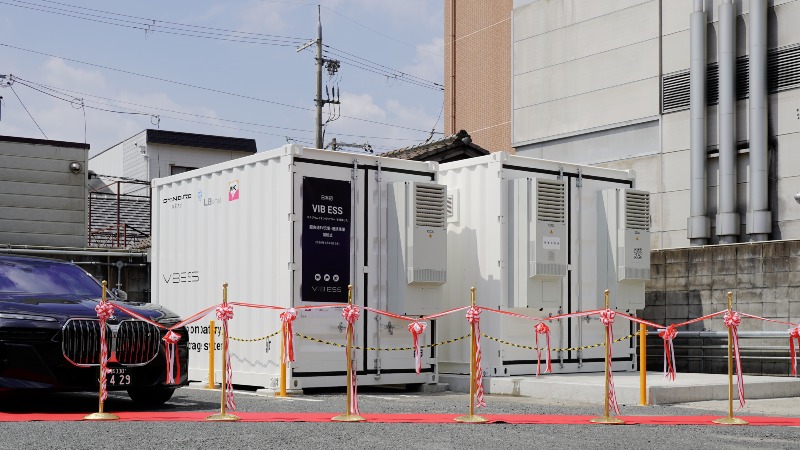
Standard Energy, a South Korean battery developer, has begun operating its first vanadium-ion battery energy storage system outside South Korea, installing the unit at the Kyoto headquarters of MK Taxi to support two ultra-fast electric-vehicle chargers.
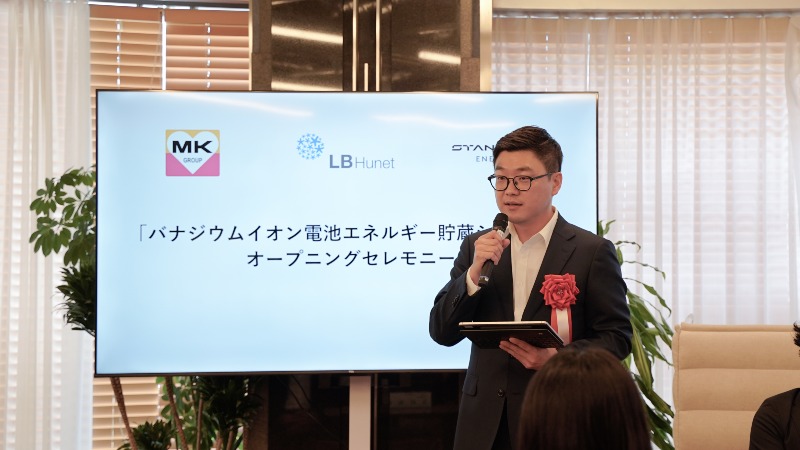
The project, launched on July 16 with MK Group and the Korean services company LB Hunet, is designed to reduce sharp spikes in electricity demand when vehicles charge at high power.
By drawing on stored energy during peak periods, the system is expected to lower demand charges and allow the site to operate more chargers without increasing its contracted power capacity.
The installation represents a commercial and regulatory milestone for Standard Energy, which says it developed the world’s first vanadium-ion battery optimized for stationary energy storage.
Before operations could begin, the equipment had to meet transportation, customs, installation and electrical requirements in both South Korea and Japan.
Standard Energy, MK Group and LB Hunet will now collect data on the system’s performance, economics and daily operation under Japanese grid conditions.
The Kyoto project builds on a 2023 agreement granting LB Hunet sales rights for the Japanese market. Since then, the partners have presented the technology at Battery Japan and worked together on customer development, demonstration projects and local regulatory compliance.
An ESS Solution Well Suited to Japan’s Expanding EV Charging Infrastructure
Japan is expanding its charging network as electric vehicles and plug-in hybrids gain ground.
The Japanese government aims to increase the number of public chargers from roughly 68,000 at the end of 2024 to about 300,000 by 2030, including approximately 30,000 fast chargers.
Ultra-fast EV chargers consume large amounts of electricity over short periods. This can place additional pressure on local power grids while increasing demand charges for charging-site operators.
Energy storage systems can ease these pressures by supplying stored electricity during periods of peak demand. This can reduce grid loads, lower electricity costs and improve the operating economics of high-capacity charging infrastructure.
Standard Energy says its battery chemistry is particularly well suited to dense urban markets, where fire safety is a central concern.
In an earlier 21-month regulatory-sandbox trial at a retail site in Seoul, a VIB system supported 2,430 ultra-fast charging sessions without a reported thermal-runaway incident.
The company believes this safety record, combined with the system’s ability to respond to high-power demand, could support wider adoption at charging stations in cities and other densely populated areas.
VIB ESS to Help Address the Challenges of the Electrification Transition
Standard Energy and LB Hunet plan to expand their cooperation beyond ultra-fast EV charging and explore broader applications for VIB ESS in Japan.
Potential markets include commercial buildings, logistics centers, industrial sites, EV charging infrastructure and residential energy storage.
Japan’s exposure to earthquakes and other natural disasters has also created demand for distributed and residential energy storage systems capable of providing backup power during grid disruptions.
Kim Bu-gi, chief executive of Standard Energy, said, “We are deeply moved that the world’s first vanadium-ion battery, developed by Korean engineers, has progressed beyond demonstrations in South Korea to its first overseas deployment.
“Beginning with this demonstration linking VIB ESS to ultra-fast EV charging at MK Taxi, we will actively expand into Japan and other overseas markets. The growth of renewable energy, electric vehicles and artificial intelligence is already a global trend, and the resulting instability of power grids is a challenge shared around the world. We intend to help address that challenge through vanadium-ion battery energy storage systems.”
Koo Bon-wan, vice chairman of LB Hunet, said, “Through this demonstration, we intend to secure sufficient data on safety, economics and operations and use it to expand VIB ESS applications across Japan’s commercial facilities, logistics centers, industrial complexes and EV charging infrastructure.
“We will continue to serve as Standard Energy’s trusted business partner in Japan, strengthen cooperation with local companies and play a responsible role in expanding sustainable energy infrastructure. We hope this first step will mark the beginning of a new era of energy cooperation between South Korea and Japan.”